
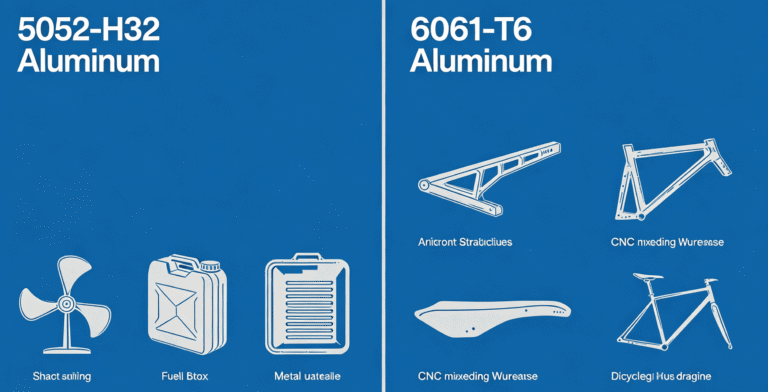
Selecting the wrong aluminum alloy for your project doesn’t just waste material—it can lead to premature part failure, costly rework, and production delays. Two of the most widely specified aluminum grades in manufacturing are 5052 and 6061, yet they behave very differently under the spindle, the press brake, and the welding torch.
This guide breaks down the key differences between 5052-H32 and 6061-T6 aluminum from a manufacturer’s perspective. You’ll learn which alloy cuts better on CNC machines, which one forms without cracking, and how to make the right choice for your specific application.
5052 vs 6061 Aluminum: Chemical and Mechanical Properties Compared
Understanding the metallurgical differences between these two alloys explains their radically different manufacturing behavior.
Chemical Composition
The primary alloying element in 5052 is magnesium (2.2–2.8%), with a small chromium addition (0.15–0.35%). This Mg-Cr combination gives 5052 its signature corrosion resistance and moderate strength without heat treatment. The absence of copper makes it highly resistant to saltwater environments.
6061, by contrast, relies on magnesium (0.8–1.2%) and silicon (0.4–0.8%) working together. When heated during T6 aging, these elements form Mg₂Si precipitates—microscopic particles that dramatically increase strength. 6061 also contains copper (0.15–0.4%), which boosts hardness but slightly reduces corrosion resistance compared to 5052.
Mechanical Properties at a Glance
| Property | 5052-H32 | 6061-T6 | Implication |
|---|---|---|---|
| Tensile Strength | 228 MPa (33 ksi) | 310 MPa (45 ksi) | 6061 is ~36% stronger |
| Yield Strength | 193 MPa (28 ksi) | 276 MPa (40 ksi) | 6061 resists deformation better |
| Elongation at Break | 12% | 12% | Similar ductility |
| Hardness (Brinell) | 60 HB | 95 HB | 6061 is significantly harder |
| Fatigue Strength | 117 MPa | 96 MPa | 5052 handles cyclic loads better |
| Elastic Modulus | 70 GPa | 69 GPa | Nearly identical stiffness |
Key insight from our machining floor: The 35-HB hardness difference between 6061-T6 and 5052-H32 translates directly to tool wear. When running 10,000+ parts in 6061-T6, we typically replace carbide inserts after roughly 800–1,200 parts. The same tool in 5052 can run 1,500–2,000 parts before indexing, provided chip control is managed correctly.
Related reading: For a broader comparison across more aluminum grades, see our CNC Machining Materials Guide.
5052 vs 6061 Aluminum CNC Machining: Which Alloy Cuts Better?
If your part requires tight tolerances and complex geometries machined from solid billet, the answer is clear: 6061-T6 is the superior choice.
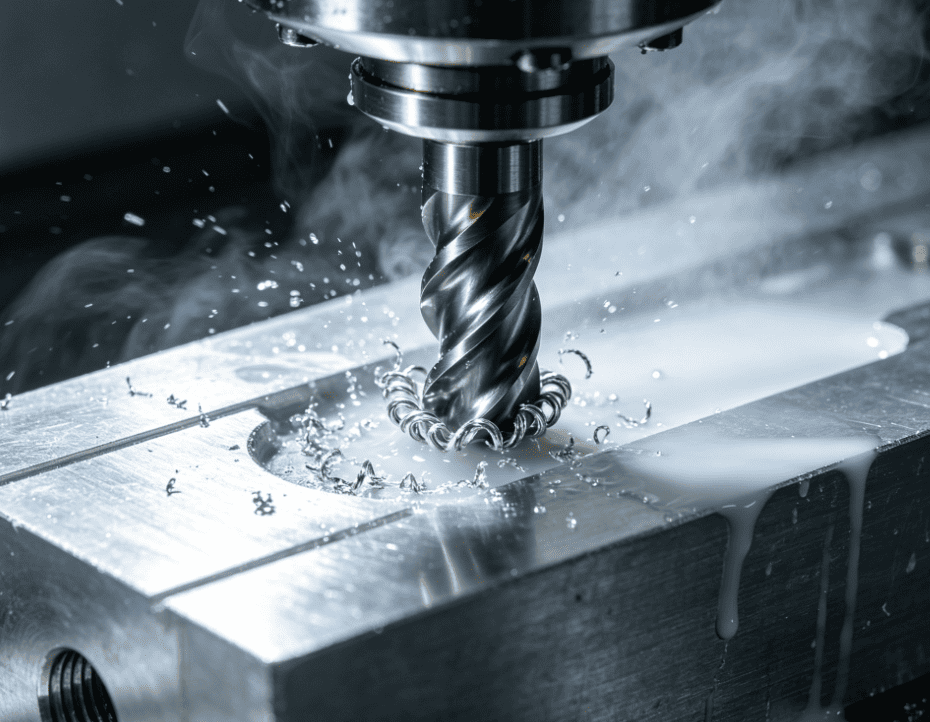
Why 6061-T6 Excels at CNC Machining
6061-T6’s higher hardness and precipitation-hardened microstructure produces small, brittle chips that break cleanly away from the cutting zone. This means:
- Better chip evacuation — no long, stringy swarf wrapping around tool holders
- Higher metal removal rates — we routinely run 6061 at 800–1,200 SFM with carbide tooling
- Superior surface finish — as-machined Ra values of 0.8–1.6 µm are achievable without secondary polishing
- Tighter tolerances — ±0.025 mm (0.001″) is standard; ±0.005 mm is achievable with our Tight Tolerance CNC Machining capabilities
Real-world example: We recently machined 500 optical sensor housings in 6061-T6 for a semiconductor equipment client. Each housing required ±0.01mm true position on eight M3 threaded holes. 6061’s chip-breaking behavior allowed unattended overnight runs with zero tool changes per shift.
The 5052 Machining Challenge
5052 is softer and more ductile. Under the cutter, it produces continuous, stringy chips that wrap around tools and can scratch finished surfaces. The magnesium in the alloy matrix also tends to build up on the cutting edge, requiring more frequent tool inspections.
However, 5052 is absolutely machinable with the right approach:
| Parameter | Recommendation for 5052-H32 |
|---|---|
| Cutting Speed | 500–700 SFM (reduced from 6061 speeds) |
| Tool Coating | Polished uncoated carbide or ZrN for reduced built-up edge |
| Coolant | High-pressure through-tool, minimum 30 bar, to blast chips away |
| Chip Breaking | Use peck drilling cycles (G73/G83) and interrupted turning paths |
| Feed Rate | 0.15–0.25 mm/rev to encourage thicker, more manageable chips |
When does it make sense to CNC machine 5052? When your part requires machining followed by extensive forming or welding—like a sheet metal enclosure that needs milled mounting bosses. In such cases, the total manufacturing efficiency of 5052 outweighs the slower machining speed.
Need precision CNC machined aluminum parts? Our 5-axis and 3-axis centers handle both 5052 and 6061 daily. Request your instant CNC machining quote.
Formability and Bending: Why 5052 Is the Preferred Choice for Sheet Metal
When your manufacturing process involves bending, deep drawing, or stamping, 5052 clearly outperforms 6061.
The Metallurgy of Formability
5052’s non-heat-treatable, solid-solution-strengthened structure means it has a more uniform grain structure. During bending, the grains slide along multiple slip planes without localized stress concentrations. Our sheet metal team regularly achieves:
- Minimum bend radius: 1T (bend radius = material thickness) for 5052-H32 in 90° bends
- Grain direction tolerance: 5052 can be bent perpendicular or parallel to grain with minimal risk of cracking
- Springback: Predictable and consistent at 2–3° for 90° bends in 3mm sheet
6061-T6, by contrast, has a precipitation-hardened microstructure where Mg₂Si precipitates pin grain boundaries. This reduces ductility locally and makes the material prone to orange-peel surface defects and edge cracking during tight-radius bends. For 6061-T6 sheet, the practical minimum bend radius is 2T to 3T—and even then, bend lines should run perpendicular to the grain direction.
Bending Process Comparison
| Factor | 5052-H32 | 6061-T6 |
|---|---|---|
| Minimum 90° bend radius (3mm sheet) | 3 mm (1T) | 6–9 mm (2–3T) |
| Grain direction sensitivity | Low | High (bend perpendicular to grain) |
| Springback compensation | 2–3° overbend | 3–5° overbend |
| Risk of cracking at tight bends | Very low | Moderate to high |
| Deep drawing suitability | Excellent | Poor |
A common mistake we see in customer drawings: specifying a 1.5mm internal radius on a 6061-T6 bracket. This almost always results in micro-cracking at the bend line. When we catch this during DFM review, we recommend either switching to 5052 or increasing the bend radius to 3mm minimum.
Working with aluminum sheet metal? Our Sheet Metal Bending Services team will review your design for manufacturability before production begins.
Welding 5052 vs 6061 Aluminum: Filler Selection and Post-Weld Performance
Welding introduces heat, and heat changes everything about aluminum. How each alloy responds to welding determines its suitability for fabricated assemblies.
5052: The Weld-Friendly Alloy
Because 5052 derives its strength from solid-solution strengthening and work hardening rather than precipitation hardening, the heat-affected zone (HAZ) does not experience the dramatic strength loss seen in heat-treatable alloys. When you weld 5052-H32:
- Filler metal: ER5356 (5% Mg) is the standard choice, matching the base metal chemistry
- HAZ strength retention: Approximately 80–85% of original yield strength
- Post-weld treatment: Not required for most applications; natural aging restores some properties
- Weldability rating: Excellent for both MIG and TIG processes
6061: Strong Base Metal, Softer Joints
6061-T6’s strength comes from Mg₂Si precipitates. Welding temperatures dissolve these precipitates in the HAZ, and natural cooling does not re-form the T6 structure. The result is a joint that’s significantly weaker than the base metal:
- Filler metal: ER4043 (Al-Si) for most applications, or ER5356 when color match after anodizing is critical
- HAZ strength retention: As low as 50–60% in the as-welded condition
- Post-weld treatment: Solution heat treatment + artificial aging (T6 recovery) can restore ~90% of strength, but adds cost and may distort the part
- Key risk: Hot cracking if using ER5356 on 6061 without proper preheat on thick sections
Welding dissimilar 5052 to 6061: When design requirements force this combination, we use ER5356 filler. The joint strength will be governed by the annealed 6061 HAZ, typically in the 150–170 MPa range.
For a deeper dive into welding techniques, see our guide on MIG vs TIG Welding.
Corrosion Resistance: When to Choose 5052 for Marine Applications
If your parts will see saltwater, chemical exposure, or outdoor weathering without protective coating, 5052 is the superior choice.
Why 5052 Resists Corrosion Better
The combination of high magnesium content (2.5% average) and the absence of copper gives 5052 exceptional corrosion resistance. Magnesium forms a more stable oxide layer that resists chloride ion attack—the primary mechanism of marine corrosion.
Independent electrochemical testing ranks alloy resistance in seawater as follows:
- 5052-O/H32 — Best performer among common wrought alloys
- 5083-H321 — Excellent marine grade, higher strength
- 6061-T6 — Good general resistance, but susceptible to pitting
Pitting Corrosion: The 6061 Vulnerability
6061’s copper content (0.15–0.4%) creates microscopic galvanic cells within the aluminum matrix. In chloride-rich environments, these become initiation points for pitting. For applications like marine electronics housings, offshore equipment brackets, or coastal architectural components, this pitting can progressively compromise part integrity.
Our recommended approach for corrosion-critical applications:
| Environment | Recommended Alloy | Surface Treatment |
|---|---|---|
| Continuous seawater immersion | 5052-H32 or 5083 | None required; optional chromate conversion |
| Marine atmosphere (above deck) | 5052-H32 or 6061-T6 | Type II anodize on 6061 |
| Industrial chemical exposure | 5052-H32 | Chromate conversion coating |
| Consumer outdoor product | 6061-T6 | Type II or Type III hard anodize |
| Medical/cleanroom | 6061-T6 | Electropolish or passivation |
For 6061 parts in marine environments, Type III hard anodizing dramatically improves pitting resistance by thickening the protective oxide layer to 25–50 µm.
Related: Learn about surface treatment options in our Chrome Plating Guide and Anodizing Defects article.
5052 vs 6061 Aluminum Cost: Is the Price Difference Justified?
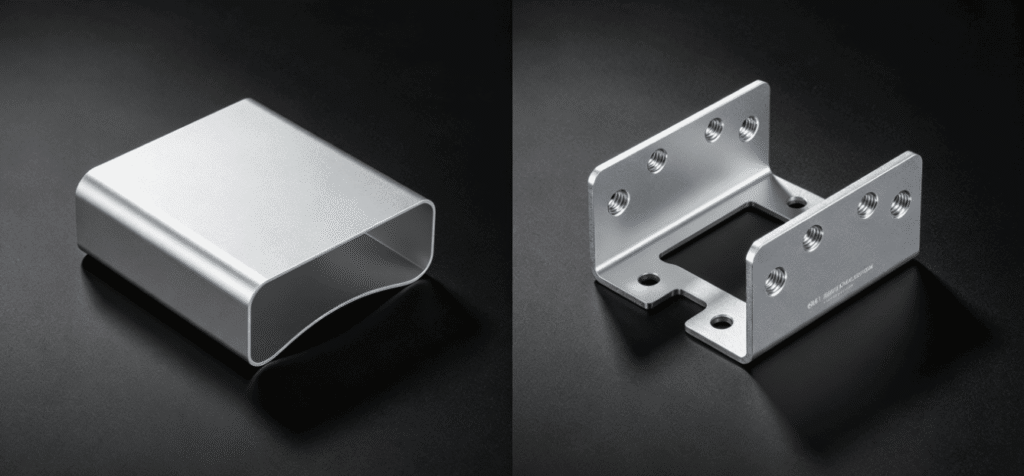
Material cost is only one component of total part cost. The alloy you choose affects machining time, tooling life, scrap rate, and secondary processing requirements.
Raw Material Cost Comparison
As of 2026, 5052-H32 sheet typically runs 5–10% less expensive than 6061-T6 plate for equivalent dimensions. However, this raw material difference is often trivial compared to processing costs.
Total Manufacturing Cost Drivers
| Cost Factor | Favors 5052 | Favors 6061 |
|---|---|---|
| Raw material price | ✓ (slightly lower) | |
| Machining cycle time | ✓ (faster, cleaner cuts) | |
| Tooling life (machining) | ✓ (softer on tools) | |
| Forming success rate | ✓ (much lower scrap) | |
| Welding post-processing | ✓ (no PWHT usually needed) | |
| Surface finish (as-machined) | ✓ (less secondary finishing) |
For a predominantly machined part: The faster cycle times and better surface finishes of 6061-T6 usually offset its higher raw material cost, making it the more economical choice.
For a sheet metal part with some machining: 5052’s superior formability and lower scrap rate typically make it the winner.
For a welded fabrication: 5052 wins unless the higher strength of 6061 is structurally necessary. Eliminating post-weld heat treatment on 5052 alone can save 15–25% on total fabrication cost.
Want an apples-to-apples cost comparison for your specific part? Upload your drawing and we’ll quote both alloys. Get your aluminum part quote.
Aluminum Alloy Selection Guide: Decision Flowchart for Engineers
Use this decision framework to quickly narrow down your alloy choice:
START: "What is my primary manufacturing process?"
├─ PRIMARY PROCESS IS CNC MACHINING
│   ├─ Requires high strength (>250 MPa yield) → 6061-T6
│   ├─ Requires excellent corrosion resistance → Consider 5052
│   └─ Requires both strength and corrosion resistance
│       └─ Can you add anodizing? → 6061-T6 + Type III Hard Anodize
│       └─ Cannot anodize? → 5052-H32
├─ PRIMARY PROCESS IS SHEET METAL FORMING
│   ├─ Tight bend radius (<2T) → 5052-H32
│   ├─ Deep drawing required → 5052-O or 5052-H32
│   ├─ Simple bends + need higher strength → 6061-T6 (watch bend radius)
│   └─ Post-forming machining needed → 5052-H32 (forms well, machinable)
├─ ASSEMBLY REQUIRES WELDING
│   ├─ Post-weld heat treatment acceptable → 6061-T6 + PWHT
│   ├─ No PWHT, moderate strength needs → 5052-H32
│   └─ Maximum corrosion resistance needed → 5052-H32
└─ OPERATING IN MARINE/CHLORIDE ENVIRONMENT
    ├─ Continuous saltwater exposure → 5052-H32
    ├─ Coastal atmosphere, appearance matters → 6061-T6 + Anodize
    └─ Submerged, high-strength needed → 5083-H321 (step up from 5052)
Still unsure? Our application engineers review material selection on every project during DFM. Contact us for a free material consultation.
5052 vs 6061 Aluminum FAQs: Expert Answers to Common Questions
Q1: What is the main difference between 5052 and 6061 aluminum for CNC machining?
The fundamental difference lies in machinability and chip control. 6061-T6 offers excellent machinability with clean chip breaking, making it the standard choice for precision CNC parts. 5052 is softer and produces long, stringy chips that require optimized chip evacuation. However, 5052 excels when a single part needs both machining and extensive forming or welding.
Q2: Can 5052 aluminum be hardened by heat treatment?
No. 5052 is a non-heat-treatable alloy from the 5xxx series. Its strength comes from magnesium solid-solution strengthening and cold working (strain hardening). The H32 temper indicates work-hardened and stabilized condition. 6061, by contrast, achieves its T6 strength through precipitation hardening of Mg₂Si particles during artificial aging.
Q3: Which aluminum alloy is better for welding—5052 or 6061?
5052 generally welds better. It retains approximately 80–85% of its original strength in the heat-affected zone because there are no strengthening precipitates to dissolve. 6061-T6 loses significant strength in the HAZ (sometimes dropping to 50–60% of original yield) unless post-weld heat treatment is applied. For dissimilar welding, ER5356 filler is the safe choice.
Q4: Is 5052 or 6061 better for marine applications?
5052 is widely considered marine-grade aluminum. Its high magnesium content and absence of copper provide exceptional resistance to saltwater pitting. 6061 offers good general corrosion resistance but is more susceptible to pitting in chloride environments. For submerged marine parts, 5052-H32 or 5083-H321 are the preferred choices.
Q5: Can I anodize both 5052 and 6061 aluminum?
Yes, but results differ. 6061 responds very well to anodizing and produces an excellent aesthetic finish, making it the preferred choice for visible components. 5052 can be anodized but the magnesium-rich surface chemistry yields different oxide layer quality. For 5052, chromate conversion coating is a common alternative to anodizing.
Q6: Is 5052 cheaper than 6061?
Raw 5052 sheet is typically 5–10% less expensive than 6061-T6 plate, but total part cost depends on your manufacturing process. For machining-dominant parts, 6061’s faster cycle times often make it more economical overall. For forming-dominant parts, 5052’s lower scrap rate and better bendability usually make it the cost-effective choice. Always evaluate total manufacturing cost, not just material price.
Q7: What if my part fails due to wrong alloy selection?
Common failure modes include:
- Cracking during bending if 6061-T6 is bent too tightly
- Thread stripping in 5052 tapped holes under high load
- Weld joint failure in 6061 without post-weld treatment
- Pitting corrosion in 6061 marine environments without coating
Each of these is preventable with correct alloy selection upfront. Our DFM review catches these issues before cutting begins.
Conclusion: Making the Right Choice for Your Project
The 5052 vs 6061 decision comes down to three practical questions:
- Will this part be predominantly machined or formed? Machined = 6061-T6. Formed = 5052-H32.
- Does this part require welding, and is post-weld heat treatment feasible? If no PWHT, lean toward 5052 unless 6061’s higher strength is essential.
- Will this part operate in a saltwater or corrosive environment? If yes and coating isn’t planned, 5052 is the safer bet.
At Baosheng, we machine both alloys daily across hundreds of customer projects. Our DFM engineers review material selection on every quote, often catching potential issues that save weeks of development time. Whether you need precision CNC machined 6061-T6 brackets, formed and welded 5052 enclosures, or help deciding between the two, we’re ready to support your project from prototype to production.
Ready to Start Your Aluminum Parts Project?
Our team provides free DFM feedback and material recommendations within 24 hours. Upload your CAD file and specify your requirements.
Request Your Free Project Review →
Or explore our capabilities:
- CNC Milling Services — Precision 3-axis and 5-axis machining
- CNC Turning Services — High-precision turned components
- Sheet Metal Fabrication Services — Cutting, bending, and welding
- Aluminum CNC Machining Quote — Specialized aluminum expertise


