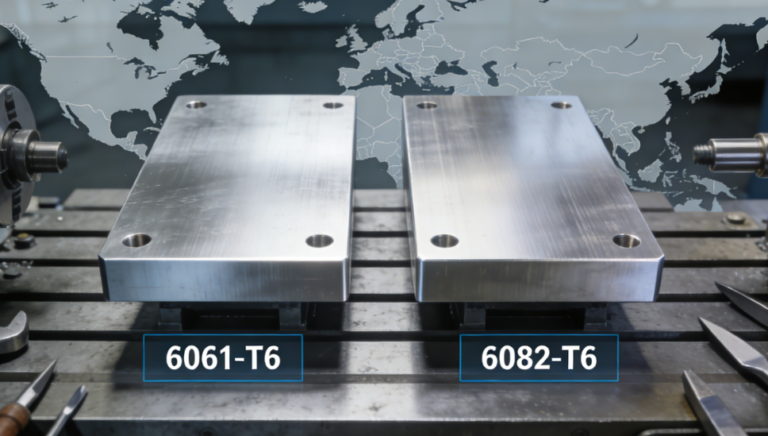
Engineers are often surprised by the difference between 6061 and 6082 aluminium alloys. This is not because the alloys are complicated, but because the right choice depends on where your parts are being made and certified. The number 6061 is what most engineers know from American datasheets and North American suppliers. The number 6082 is what European stockists actually carry, what EN 573-3 references, and what most European structural projects specify by default.
The difference between what engineers specify and what European suppliers stock costs money because it takes time, and also because of problems with certification and buying things. This article gives you the actual property numbers, the EN standard context, and a decision framework for each application type. This means you can specify the right alloy the first time.
Applicability: This guide is for engineers and buyers who are looking for aluminium parts for use in European structures, cars, boats, or industry. If you’re sourcing domestically in North America and there’s no requirement for CE or EN certification, 6061 is likely your go-to choice, and most of the sourcing logic here won’t apply.
6061 vs 6082 Aluminum: Side-by-Side Property Comparison
Before the context and nuance, here are the numbers. Both alloys are compared in T6 temper — the heat-treated condition used in the overwhelming majority of structural and machined applications.
| Property | 6061-T6 | 6082-T6 | Edge |
|---|---|---|---|
| Tensile Strength (UTS) | 290–310 MPa | 310–340 MPa | 6082 |
| Yield Strength | 241–276 MPa | 255–310 MPa | 6082 |
| Elongation at Break | 12–17% | 10–14% | 6061 |
| Fatigue Strength | 58–110 MPa | 55–130 MPa | 6082 (peak) |
| Shear Strength | 84–210 MPa | 84–220 MPa | 6082 (marginal) |
| Machinability | Excellent | Good | 6061 |
| Weldability | Good | Good | Tied |
| Manganese Content | ≤0.15% | 0.4–1.0% | — |
| Silicon Content | 0.4–0.8% | 0.7–1.3% | — |
| Density | 2.70 g/cm³ | 2.70 g/cm³ | Identical |
| Thermal Conductivity | ~170 W/m·K | ~160 W/m·K | 6061 |
| Primary Standard | ASTM B209 | EN 573-3 | Context-dependent |
| European Stock Availability | Limited | High | 6082 |
6082 delivers 10–18% higher tensile strength than 6061 in comparable temper conditions. That performance gap is meaningful in structural applications — but so is the machinability difference in a high-volume CNC context.
6061 vs 6082 Aluminum: What the Composition Difference Actually Does
The manganese is the most important thing. The only thing that affects how well these two alloys work is that one element.
Both alloys use magnesium and silicon to form Mg2Si precipitates, which make them strong after they are heated. The main difference is the amount of manganese — 6082 has 0.4–1.0% manganese, while 6061 has ≤0.15%. Manganese makes the metal stronger because it changes the way the grains are arranged when the metal is cast and then stretched.
The engineering implication is straightforward: if you’re designing a structural beam using 6082 instead of 6061, you can reduce the thickness of the material by around 10% without affecting its load-bearing capacity. For transport and infrastructure projects in Europe where the cost of materials is calculated for thousands of linear metres, that margin directly affects the project’s finances.
The trade-off is direct. 6061 is well-liked because it can be easily and efficiently machined. It cuts cleanly using standard tools, lubricants and cutting speeds. 6082 can still be machined, but you need to use slower cutting speeds because it is harder and the silicon and manganese in it cause it to wear the tool. The difference in the time it takes to make a complex 5-axis part with deep cavities and fine features, and the cost of the tools needed, is real.
6061 vs 6082 Aluminum: European Standards and Sourcing Reality
This is where most comparison articles stop short — and where the decision actually gets made for European projects.
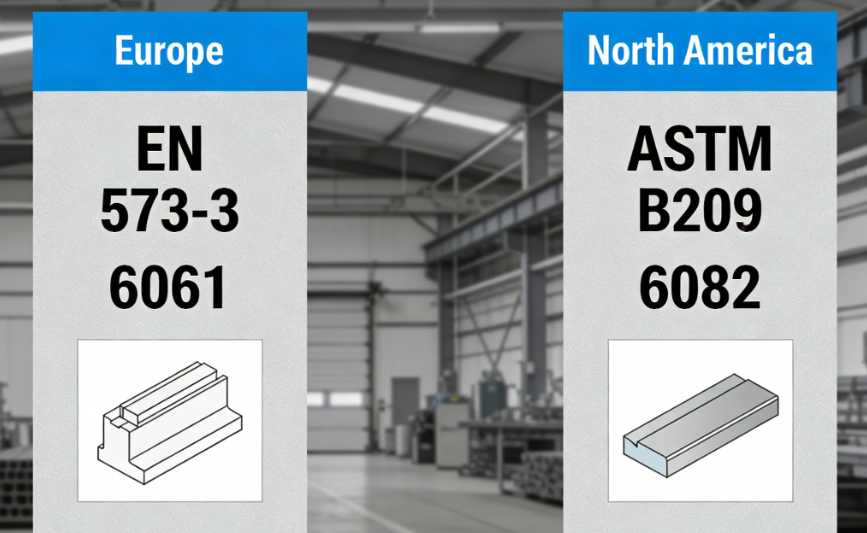
The standard gap is not negotiable.
The European standard for wrought aluminium alloys, EN 573-3, does not recognise 6061. European structural projects that need EN certification cannot formally specify 6061 without triggering a material equivalency review.
The code 6082 is used for a type of aluminium alloy called EN AW-6082, as defined in EN 573-3. This alloy is commonly used in various engineering projects in Europe, such as plates, extrusions, structural sections and precision bars.
If your drawing says EN AW-6082 and a supplier quotes 6061 as a direct equivalent, that is a certification problem, not a material substitution.
Stock availability in Europe follows the standard.
The most common type of aluminium used in European engineering workshops and machine shops is 6082. Plate, round bar, flat bar, and extrusions in 6082-T6 and T651 are kept in stock by almost all European aluminium distributors.
6061, on the other hand, often needs to be imported from North America or there are special orders that take time and sometimes there are minimum order amounts that make it not worth buying small amounts.
Regional default by country.
6061 is the most common type of aluminium used in North American manufacturing. You can find it almost everywhere there.
In Germany, the UK, the Netherlands and Scandinavia, 6082 is now the most common structural alloy. Engineers who trained in Europe will often use 6082 by instinct; engineers who trained in North America often use 6061 and then have problems when the project moves to European manufacture.
→ Get Aluminum CNC Milling With Material Certification We machine both 6061 and 6082, supply EN 10204 3.1 mill certificates on request, and quote to your drawing — not a material catalogue. Tell us your alloy, temper, and tolerance requirements.
6061 vs 6082 Aluminum: Cost & Decision Logic by Application
The right alloy is application-specific. Here is the direct ruling for each major use case.
Structural and Load-Bearing Components
Choose 6082. For European structural applications, such as frames, beams, bridge components and machinery bases, the correct specification is 6082-T6. The EN certification trail is clean, the stock is available immediately, and the 10–18% strength advantage over 6061 allows engineers to optimise cross-sections for weight.
6082 is the best choice for building bridges in Europe, as well as for making heavy machinery frames and transportation structures. It is good because it can make these structures lighter, which means they work better or cost less.
For automotive and transport applications specifically, 6082’s combination of high yield strength and good corrosion resistance makes it the standard choice for suspension components, structural brackets, and body-in-white structural elements in European vehicle programs.
Marine and Corrosion-Critical Applications
Choose 6082. Both alloys are good at protecting against rust, but 6082 performs better in high-salt and marine environments because of its grain structure and lower copper content (≤0.10% vs. up to 0.40% in 6061). Copper in aluminium alloys can cause problems in the sea.
For use in the marine and shipping industries, where parts will be exposed to salt water for a long time, 6082 can last longer without needing an extra layer of protection.
Precision CNC Machined Parts — Prototype and Low Volume
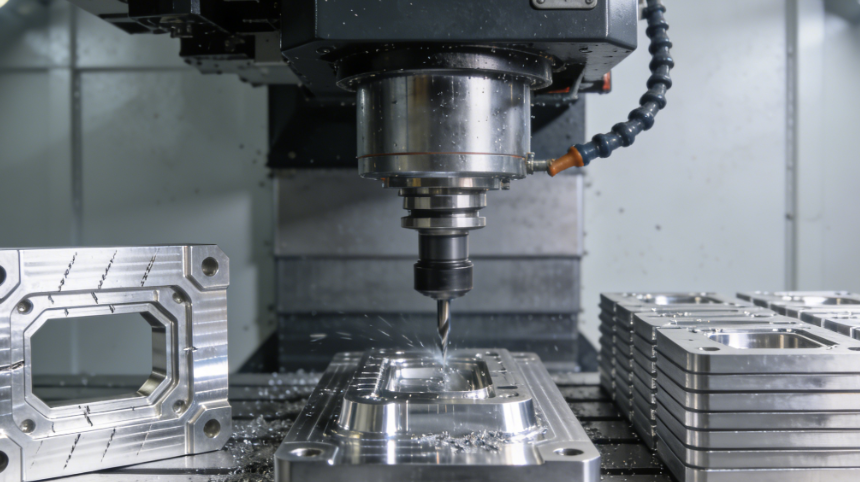
Choose 6061. When EN certification isn’t needed and the priorities are making sure the size is accurate, the surface finish is good, and the machining cost is low, 6061 is the better choice.
It is easier to use and produces a cleaner surface on fine features, tight internal radii, and threaded features. Shapes with complex surfaces and walls less than 2mm thick, or with deep cavities, are better suited to 6061 because it has lower cutting forces. This reduces the chance of the material bending or changing shape during cutting.
For rapid prototyping where the goal is functional evaluation rather than production certification, 6061-T6 gives you faster cycle times and lower per-part cost — relevant when you’re iterating through five design revisions before freezing a drawing.
High-Volume Production Machining
Don’t worry about the price of the material, just work out how much the part costs. 6082 costs a little more per kilogram, but the difference in machining costs is bigger than most buyers expect.
Reducing the cutting speed in 6082 can make complex parts 15–25% faster and means you don’t have to change tools as often.
When making 500 of something, it’s often not worth the extra money to do more complicated machining, because the parts you’re making aren’t the main structure.
If the application doesn’t require EN certification or the structural advantage, 6061 frequently delivers a lower total part cost in high-volume CNC production.
Welded Assemblies
Choose 6061 for complex multi-pass welds; 6082 for simpler structural welds. Both alloys are weldable, but 6061 responds more predictably to heat in real workshop conditions — particularly in assemblies with multiple welded joints followed by machining operations. 6082 requires tighter heat input control to avoid HAZ (heat-affected zone) softening.
For aerospace applications with tight post-weld dimensional requirements, the additional heat management overhead of 6082 is worth engineering into the process. For general fabrication, 6061 is more forgiving.
Anodized and Surface-Treated Parts
6082 performs well; 6061 is more consistent. Both alloys anodize cleanly, but 6061’s more uniform silicon distribution produces slightly more consistent colour in decorative anodizing. 6082 performs well in hardcoat anodizing and is commonly specified for architectural extrusions where hardcoat thickness and adhesion are critical.
For consumer product applications where aesthetic consistency across a production batch matters, test both with your anodizing supplier before committing.
The EN 10204 3.1 Certificate Question
For any kind of structural or regulated application in Europe, it is essential to be able to track the materials. EN 10204 3.1 certification means that an accredited laboratory has checked the material properties and can link them to the specific batch.
For medical device applications and semiconductor equipment, this ability to follow the product’s history often extends to the CNC machined part, not just the raw material.
Ask your supplier if they can provide EN 10204 3.1 mill certificates for the specific alloy and temper you require. A supplier who has 6082 in stock from a European mill that is approved by the relevant authorities can easily provide this. A supplier who imports 6061 from a source that is not certified cannot do so.
Supplier Questions That Separate Capable Vendors From Guesswork
Most shops will quote either alloy. Fewer can actually deliver the documentation and process control that European structural and regulated applications require. These four questions find the difference quickly.
- Can you supply EN AW-6082 with EN 10204 3.1 mill certification? If the answer involves any hesitation or a request to “check with the supplier,” your material traceability is at risk.
- For 6061 on a European project — what is your lead time from a European warehouse? If the answer is “we import from our US stock,” factor 4–8 weeks into your schedule.
- For tight-tolerance machined parts in 6082-T6, what cutting speed reduction do you apply vs. 6061? A vendor with no answer hasn’t optimized their process for the material.
- Can you supply T651 condition for plate over 40mm? T651 (stress-relieved by stretching) is critical for dimensional stability in precision machined parts over 40mm thick. Standard T6 plate in that thickness range carries residual stress that releases during machining and causes flatness deviation.
Engineering checkpoint: For plate parts over 40mm machined to tight flatness tolerances, always specify T651 — not T6. The stress relief step is what keeps the part flat after the fixture is removed.
→ Send Your Drawing for an Aluminum Machining Quote We machine 6061 and 6082 in T6, T651, and custom tempers. EN 10204 3.1 certificates available on request. Tell us your alloy, quantity, and tolerance — we’ll confirm lead time and material availability in one response.
6061 vs 6082 Aluminum: Where Each Alloy Belongs
6061 and 6082 are not interchangeable once EN standards, European stock reality, and structural certification are considered. They are two strong alloys that solve slightly different problems in different supply chain contexts.
The correct default setting for European structural applications, marine environments, high-load components and any project where EN certification is required is 6082. The best choice for most applications is 6061, which is great for prototype CNC machining, complex welded assemblies, North American supply chains, and applications where the machine can easily cut it and it doesn’t cost too much is important.
If you need to specify parts for a European automotive Tier 1 or UK infrastructure project, make sure you use the 6082-T6 designation (also known as EN AW-6082). And don’t forget to confirm that your supplier has the EN 10204 3.1 certification.
It is better to run a machined prototype in low volume with no EN requirement, or to source it from North America. This costs less, machines faster, and delivers the same functional performance for most non-structural uses.
If you’re using a European machine shop for production, make sure you ask what they actually have in stock before you finalise the drawing. The answer is usually 6082, and if you design around that from the start, you won’t need to go back and change things later.
Frequently Asked Questions
Is 6082 aluminum the same as 6061?
No. Both are 6000-series aluminum alloys, but 6082 contains significantly more manganese (0.4–1.0% vs. ≤0.15%), which gives it higher tensile and yield strength. They also operate under different standards — 6061 under ASTM B209, 6082 under EN 573-3 — which affects certification requirements on European projects.
Which aluminum alloy is used in Europe instead of 6061?
6082 is the standard structural aluminum alloy in Europe and functions as the practical equivalent of 6061 for most applications. It is stocked by default across European distributors in plate, bar, and extrusion form, and is referenced in EN 573-3. 6061 is not covered by the EN standard and is rarely stocked in Europe.
What is the EN standard equivalent of 6061 aluminum?
There is no direct EN equivalent of 6061. The closest alloy under EN 573-3 is EN AW-6082, which offers higher strength than 6061. For projects requiring EN certification, 6082 is the correct specification — not a 6061 substitute.
Is 6082 or 6061 better for CNC machining?
6061 machines more easily. It produces cleaner chips, tolerates standard cutting speeds, and causes less tool wear than 6082. 6082 requires reduced cutting speeds and more frequent tool changes due to its higher hardness and silicon content. For complex parts or high-volume production, the cycle time difference is measurable.
Why is 6082 more common than 6061 in the UK and Germany?
6082 is standardized under EN 573-3, the European wrought aluminum standard. European structural codes and procurement specifications reference EN standards by default, so 6082 became the dominant stock alloy across UK and German distributors. 6061 has no EN designation and is not commonly stocked in European warehouse networks.
Can 6061 and 6082 be welded together?
Yes, they can be joined using standard MIG or TIG welding with 4043 or 5356 filler wire. In practice, mixing alloys in a welded assembly adds complexity to post-weld heat treatment and certification, and is generally avoided in structural applications where documentation is required.
Related Resources
From this site:
6061 vs 7075 Aluminum — When You Need the Stronger Alloy
Manufacturing capabilities:
CNC Milling Services · CNC Turning Services · High-Volume CNC Machining · Rapid Prototyping
Industry applications: Automotive · Aerospace · Marine · Medical · Energy