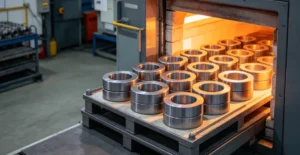
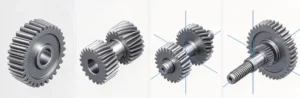
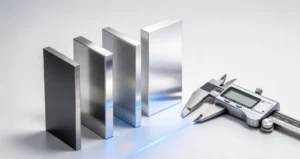
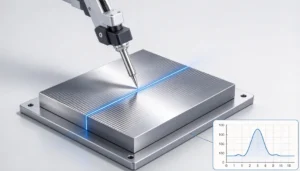
In metallurgy, annealing is a heat treatment that uses controlled heating, holding and cooling to obtain a required material condition. Common aims include softening, restoring ductility after cold work and reducing residual stress. The result depends on the alloy, starting condition and thermal cycle; annealing does not automatically increase strength.
For a machined part, the practical question is which condition the drawing requires at delivery. A softer material may be easier to form, while a strength-critical component may need a different final treatment.
how does annealing work?
The annealing process has three furnace operations: heating, holding and cooling. Their settings must suit the material and the intended metallurgical change.
1. Heat to the specified temperature
The part is brought to the temperature required by the selected treatment. Alloy chemistry, prior cold work, existing microstructure and section thickness affect the process selection.
A recrystallization threshold alone does not define the required cycle. A steel full anneal, a subcritical treatment and solution annealing of stainless steel have different purposes and temperature requirements.
2. Hold long enough for the required change
The hold, or soak, allows the intended changes to develop after the relevant part sections reach the required temperature. Furnace temperature alone may not describe the temperature throughout a thick or complex part.
Specify the holding requirement through the applicable process specification. A fixed time per part cannot be selected from the word anneal alone.
3. Cool at the required rate
Cooling helps determine the resulting structure and properties. Slow furnace cooling is associated with full annealing of suitable steels, but other treatments require rapid cooling.
Choose the cooling method for the specified alloy and treatment. The same instruction, such as “cool slowly,” cannot be applied indiscriminately to steel, stainless steel and aluminum.
Recovery, recrystallization and grain growth
These are microstructural mechanisms, distinct from the furnace operations above. They are particularly relevant to annealing cold-worked metals.
- Recovery: defects rearrange or are reduced, and some stored deformation energy is released. The original grain structure is largely retained.
- Recrystallization: new grains replace the deformed structure, producing substantial softening in a suitably cold-worked material.
- Grain growth: existing grains grow at the expense of others as the thermal exposure continues.
Heating does not map exclusively to recovery, holding to recrystallization and cooling to grain growth. The changes depend on time, temperature and material history. A cycle intended only for stress relief may not aim for full recrystallization.
Common types of annealing
| Treatment | Purpose and relevant material context |
|---|---|
| Full annealing | Softens suitable steels through a specified heating cycle and slow cooling, usually in the furnace. |
| Process annealing | Restores workability after cold deformation; the intended degree of softening depends on the material and subsequent operation. |
| Spheroidizing annealing | Produces a globular carbide structure in suitable steels to support cold forming or subsequent processing. |
| Homogenization / diffusion annealing | Reduces chemical segregation through diffusion; it is selected for an appropriate alloy and initial structure. |
| Solution annealing | Dissolves relevant constituents into solution and uses the specified cooling route; an important example is treatment of austenitic stainless steel. |

Spheroidizing in steel concerns carbides, such as cementite. It should not be confused with producing spherical graphite in ductile iron.
Bright annealing describes treatment with atmosphere control that limits surface oxidation. The required metallurgical cycle still depends on the material; the word bright does not define a universal temperature or final hardness.
Why the cooling method changes with the material
| Material and treatment | What the cooling requirement means |
|---|---|
| Suitable carbon or alloy steel: full annealing | Controlled slow cooling supports the intended soft structure. Use the grade-specific cycle. |
| Austenitic stainless steel: solution annealing | Rapid cooling is generally required. Air or water cooling is selected according to grade, section and specification. |
| Aluminum alloy: softening anneal | Heating, holding and cooling must match the alloy, prior temper and required final condition. Do not substitute a solution-treatment-and-aging cycle. |

Conceptual comparison only. Select the complete cycle from the applicable material and process specifications.
For stainless steel, cooling that is too slow can permit detrimental precipitation. Rapid cooling can also introduce residual stress where section thickness varies, so the complete cycle needs to account for geometry.
Surface condition matters as well. Annealing stainless steel in air can produce oxide scale that requires appropriate removal. A bright surface and an acceptable microstructure are separate requirements.
What aluminum annealing means for the final temper
Aluminum alloy numbers identify composition; temper designations describe processing condition. The drawing should specify both.
Hydro’s 6061 technical data distinguishes these conditions:
| 6061 condition | Meaning for the specified product |
|---|---|
| O | Annealed to obtain the lowest-strength temper. |
| T6 | Solution heat-treated and artificially aged. |
| T6511 | Solution heat-treated, stress-relieved by stretching and artificially aged; used for the applicable extruded products. |
These conditions are not interchangeable. For example, Hydro’s 2019 extrusion data lists a maximum 0.2% offset yield strength of 110 MPa for O temper, compared with a minimum of 240 MPa for T6/T6511 in the listed product ranges. These are supplier-listed limits, not measured before-and-after results from a single part or universal values for every 6061 product.
A full softening anneal changes the precipitation-hardened condition of 6061-T6. A required T6 delivery state needs an appropriate solution-treatment, quenching and aging route, with acceptance to the specified requirements.
Stress relief by stretching in T6511 is a mechanical processing step. It does not mean the material has received a softening anneal.
For related part requirements, see our 6061 aluminum CNC machining information.
Drawing example: “6061-T6, anneal after machining”
This is a hypothetical specification example, not a Baosheng production case. The note leaves the final condition unresolved.
Before manufacture, clarify:
- Is the part intended to remain in T6, or is an annealed condition acceptable?
- Is the objective bulk softening, improved formability or reduced residual stress?
- Which treatment specification and final mechanical properties apply?
- Which dimensions and geometric characteristics must be inspected after the relevant thermal operations?
The designer should resolve the final condition before the machining and heat-treatment route is released. Changing the cycle to make the part softer may conflict with the required delivered strength.
Preparing a part for quotation?
Send the drawing, CAD model and alloy/temper requirements. Identify the required final condition and any thermal-processing specification so the machining scope can be assessed.
Annealing, normalizing, tempering and stress relieving
These terms identify different treatment objectives. The steel comparisons below should not be transferred directly to aluminum alloys.
| Treatment | Main distinction |
|---|---|
| Full annealing of suitable steel | Uses a slow-cooling route to obtain the intended soft condition. |
| Normalizing of suitable steel | Uses heating followed by air cooling to develop the specified structure and properties. |
| Tempering of hardened steel | Follows hardening to obtain the required hardness and toughness balance. |
| Stress relieving | Targets residual stress; the cycle must be compatible with the existing material condition. |
Stress relief is relevant to parts that may move during later processing. It does not remove the need to control machining sequence, clamping and material removal. Our guide to aluminum part warping discusses those related causes of flatness problems.
Does annealing improve CNC machinability?
It can, particularly when a suitable steel is too hard for the intended cutting or forming operation. Spheroidizing can produce a structure that supports machining or cold working in the appropriate grade.
Softer is not always easier to machine. An excessively soft, ductile condition can promote material sticking to the cutting tool. Tool geometry, cutting conditions, chip formation and the material’s final strength requirement still matter.
For precision parts, plan heat treatment and final machining together. Where an intermediate treatment is specified, allow for its possible dimensional effects before defining the finishing and inspection sequence. Our CNC machining services provide the starting point for a project inquiry; specific heat-treatment requirements should be confirmed during quotation.
Specify the delivered condition
A useful RFQ should include:
- Material grade, product form, incoming temper and required final condition.
- Drawing revision, CAD model and quantity.
- Treatment name, governing specification and any approved process requirements.
- Required hardness or mechanical properties, with the specified acceptance method.
- Critical dimensions, geometric tolerances, surface condition and inspection records.
Show the required relationships between functional features on the drawing. Our guide to geometric tolerancing symbols explains the relevant drawing language.
FAQ
what is the annealing temperature?
There is no single temperature for every alloy and treatment. Grade, prior condition, section size and the target microstructure determine the cycle. Obtain the required temperature, holding time and cooling instructions from the applicable material or process specification.
Does annealing make metal stronger?
The annealing definition does not imply increased strength. Softening a work-hardened or precipitation-hardened metal generally reduces strength and hardness while improving formability. Select a strengthening treatment separately when higher delivered strength is required.
Can metal be annealed more than once?
Repeated treatment, sometimes written as “re annealing,” can be used between forming operations. Review the accumulated cold work and thermal history before selecting another cycle. Repeated heating does not automatically return a part to a specified temper. Assess cracks, porosity or dimensional errors separately before approving further treatment.
Which terminology should a material specification use?
Use anneal as the verb and name the specific treatment and final condition. Search phrases such as “anneal meaning” and “annealing metallurgy” do not define a production cycle. Correct misspellings such as “annealation” and “nnealing” to annealing before issuing a specification.
Request a quote with the final material condition defined
Successful annealing starts with the alloy, initial condition and required result. For a CNC part, the process route must also address final dimensions, mechanical properties and surface requirements.
Request a CNC machining quote from Baosheng with your controlled drawing, CAD model, material condition and quantity. Include any annealing specification and required certificates so the thermal-processing scope can be reviewed with the machining requirements.