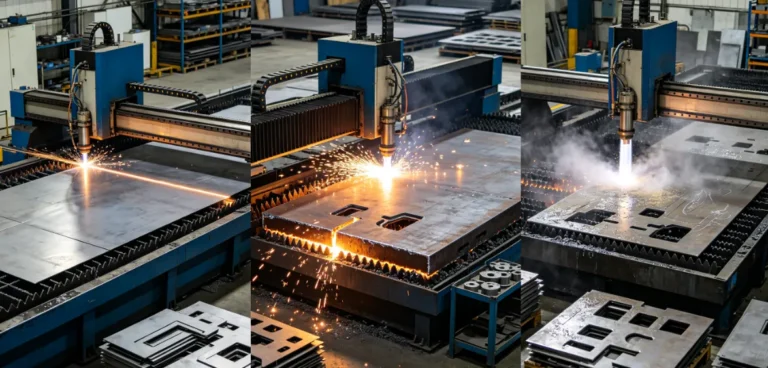
Choosing between laser, plasma, and waterjet cutting depends on the part—not simply on the machine.
Material, thickness, tolerance, edge quality, heat sensitivity, production volume, and total cost all affect the right choice.
Laser cutting is often a strong option for thin sheet metal, detailed profiles, and tight features. Plasma cutting is useful for thicker conductive plate where cutting speed matters. Waterjet cutting stands out when heat input needs to be minimized or the material is difficult to process with thermal cutting.
This guide compares laser vs. plasma vs. waterjet and shows how to choose the right sheet metal cutting process for your part.
Which Sheet Metal Cutting Process Should You Choose?
There is no single best cutting method for every application.
Use the following as a starting point:
| Part Requirement | Process to Consider |
|---|---|
| Thin sheet metal with fine features | Laser cutting |
| Small holes and detailed profiles | Laser cutting |
| Thick conductive plate | Plasma cutting |
| High cutting productivity on thick plate | Plasma cutting |
| Minimal thermal impact | Waterjet cutting |
| Heat-sensitive material | Waterjet cutting |
| High-precision sheet metal profiles | Laser cutting |
| Broad material compatibility | Waterjet cutting |
These are general guidelines. Material grade, thickness, geometry, tolerance, machine capability, and downstream fabrication can change the best process for a specific part.
How Do Laser, Plasma, and Waterjet Cutting Work?
The three processes remove material in different ways. That difference affects cutting speed, edge quality, heat input, and material suitability.
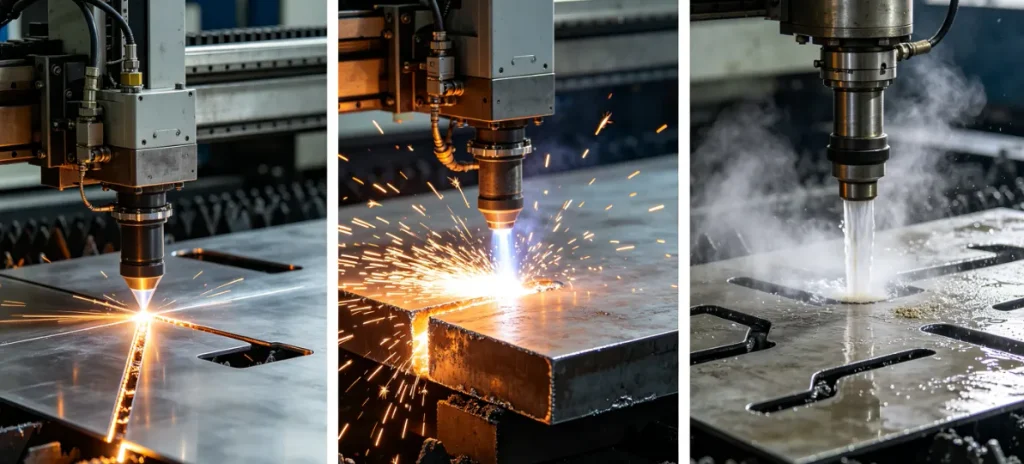
Laser Cutting
Laser cutting uses a focused beam to melt or vaporize material along a programmed path. Assist gas removes molten material from the cut zone.
The concentrated beam supports narrow kerfs, detailed profiles, and small features. For many sheet metal applications, laser cutting offers a useful balance of speed, dimensional control, and edge quality.
Plasma Cutting
Plasma cutting uses an electrical arc to ionize gas and create a high-temperature plasma jet. The plasma melts electrically conductive material, while the gas stream removes the molten metal.
Plasma is well suited to thicker conductive plate. Cut quality depends on factors such as material thickness, cutting speed, torch condition, gas selection, and machine capability.
Waterjet Cutting
Waterjet cutting uses a high-pressure water stream, often with abrasive particles, to remove material mechanically.
Because it does not rely on conventional thermal cutting, waterjet avoids the heat-affected zone associated with laser and plasma. This makes it useful for heat-sensitive applications and materials that are difficult to process with thermal methods.
The main trade-off is speed. Waterjet cutting is generally slower than laser or plasma for many common metal applications.
Laser vs. Plasma vs. Waterjet: What Are the Main Differences?
A useful CNC cutting comparison should focus on the finished part, not just the machine.
| Factor | Laser Cutting | Plasma Cutting | Waterjet Cutting |
|---|---|---|---|
| Cutting method | Focused thermal beam | Electrical arc and plasma | High-pressure abrasive jet |
| Main strength | Precision and detailed profiles | Thick conductive plate | Cold cutting and material flexibility |
| Thin sheet metal | Strong fit | Less suited to fine features | Suitable but often slower |
| Thick plate cutting | Equipment-dependent | Strong fit | Strong fit |
| Cutting accuracy | Generally high | Depends on equipment and settings | Generally high |
| Edge quality | Clean on suitable material | Dross or taper may require cleanup | Good, with possible taper or striation |
| Heat input | Yes | High | No conventional thermal cutting |
| Heat-affected zone | Present | Present | None |
| Fine features | Excellent fit | More limited | Good |
| Material range | Broad range of metals | Electrically conductive materials | Very broad |
| Cutting speed | Fast in its suitable range | Strong on thick conductive plate | Generally slower |
| Secondary finishing | Often limited | May be required | Depends on application |
The best process depends on which factor matters most.
A faster cut may require more edge cleanup. A higher cutting rate may still produce a lower finished-part cost when it reduces grinding or deburring.
How Does Material and Thickness Affect Cutting Process Selection?
Material and thickness are usually the first two variables to check.
They help narrow the practical process range before you compare tolerance, edge quality, or cost.
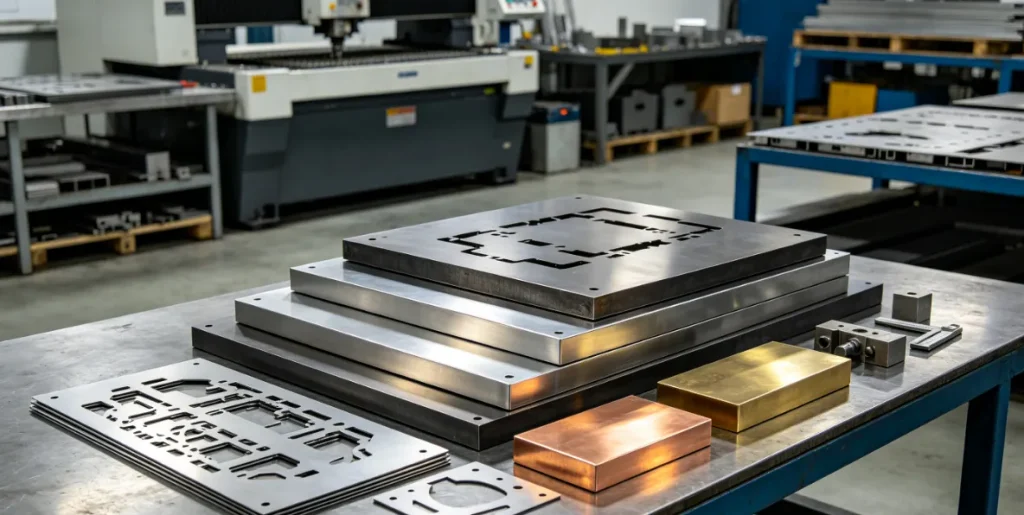
Carbon Steel and Mild Steel
Laser cutting is often a good fit for carbon steel sheet with detailed profiles, small holes, or tighter dimensional requirements.
As thickness increases, plasma cutting can become more attractive when the geometry is simple and cutting productivity matters more than fine-feature capability.
Stainless Steel
Stainless steel can be processed by laser, plasma, or waterjet. The best option depends on thickness, geometry, tolerance, and edge requirements.
Laser cutting is often practical for precision stainless steel sheet metal. Waterjet becomes more attractive when minimizing thermal effects is important.
For more practical guidance, see our guide to how to cut stainless steel.
Aluminum
Aluminum requires attention to thermal behavior and process capability.
Laser cutting can be effective for precision aluminum sheet metal when the material and thickness are within the machine’s suitable range. Waterjet is worth considering when thermal effects should be avoided.
Copper and Brass
Copper and brass can be more demanding for thermal cutting because of their high thermal conductivity and, depending on the alloy, reflective characteristics.
These factors can make laser process selection more sensitive to equipment and cutting parameters. Waterjet can be useful when thermal cutting creates limitations.
Thin Sheet vs. Thick Plate
Thickness alone should not determine the process.
Modern laser, plasma, and waterjet systems have overlapping application ranges. The actual choice also depends on geometry, feature size, tolerance, edge quality, and production requirements.
A better question is:
Does the part need fine features and tight dimensional control, or is it mainly a thick-plate cutting job where productivity matters more?
How Do Accuracy, Edge Quality, and Heat Affect the Decision?
Once material and thickness are known, define what the cut edge needs to achieve.
Cutting Accuracy and Dimensional Control
Cutting accuracy matters when the cut profile becomes a functional feature.
Small holes, narrow slots, and mating profiles place greater demands on kerf control, machine motion, material stability, and process parameters.
Laser cutting is generally well suited to detailed sheet metal profiles. Waterjet can also produce accurate profiles when avoiding thermal effects is important.
Plasma can provide good production accuracy with suitable equipment and settings, but its suitability depends more heavily on material thickness and the required tolerance.
The key question is not which process has the best advertised accuracy.
It is whether the process can repeatedly hold the tolerance required by the drawing.
Edge Quality: Burrs, Dross, Taper, and Kerf
The cut edge can affect both appearance and downstream fabrication.
Laser cutting can produce a clean edge and narrow kerf on suitable sheet metal. Plasma cutting may produce dross, edge bevel, or angularity that requires additional cleanup.
Waterjet avoids thermal dross, but the edge can show taper or striation depending on material thickness, cutting speed, and the required cut quality.
This matters when the edge becomes part of a mating feature or when secondary grinding and deburring would add significant cost.
Heat-Affected Zone and Thermal Distortion
Laser and plasma are thermal cutting processes, so both introduce heat into the material.
The practical effect depends on the material, thickness, geometry, and cutting parameters.
Waterjet is a cold cutting process. It therefore avoids the conventional heat-affected zone associated with thermal cutting.
This can be useful when thermal distortion or heat-related changes in material properties could affect part performance.
The absence of a HAZ does not automatically make waterjet the better choice. Speed, cost, thickness, and edge requirements still matter.
When Should You Choose Laser, Plasma, or Waterjet?
The right choice depends on the trade-off that matters most for the part.
Laser Cutting vs. Plasma Cutting
Choose laser cutting when the part requires:
- thin or medium sheet metal
- small holes
- detailed profiles
- tighter dimensional requirements
- controlled edge quality
Consider plasma cutting when the job involves:
- thicker conductive plate
- simpler profiles
- less demanding feature size
- strong emphasis on cutting productivity
The basic trade-off is precision and fine geometry versus productivity on thicker conductive material.
Laser Cutting vs. Waterjet
Laser cutting is often preferred when sheet metal production requires speed, repeatability, and efficient processing.
Waterjet becomes more attractive when:
- thermal distortion is a concern
- heat-sensitive material is involved
- reflective material creates laser-processing limitations
- material properties must be preserved
- cold cutting is preferred
The key question is whether the part benefits more from laser productivity or waterjet’s low-heat cutting characteristics.
Plasma Cutting vs. Waterjet
Plasma is often attractive for thick conductive plate where cutting speed and production economics matter.
Waterjet becomes more useful when:
- heat must be minimized
- the material is difficult to cut thermally
- edge quality is important
- secondary edge cleanup would be costly
- a cold cutting process is preferred
The relevant comparison is finished-part cost, not only machine rate.
How Do Cutting Speed and Total Cost Affect Process Selection?
The lowest cutting rate does not always produce the lowest cost per part.
Cutting Speed
Laser cutting is highly productive on suitable thin and medium sheet metal.
Plasma can be competitive on thicker conductive plate. Waterjet is generally slower for common metal applications.
The right comparison depends on the material, thickness, geometry, and required cut quality.
Material Utilization
Nesting efficiency, part spacing, kerf width, and scrap all affect material cost.
A process that supports efficient nesting may reduce total sheet consumption.
Secondary Finishing
Some parts require:
- deburring
- grinding
- edge cleanup
- drilling
- additional machining
These operations are part of the manufacturing cost.
A lower cutting price may not be cheaper after post-processing is included.
Total Part Cost
For sourcing decisions, compare:
Material + Cutting + Setup + Secondary Finishing + Downstream Fabrication
This gives a better view of manufacturing cost than comparing hourly machine rates alone.
How Do Secondary Operations Affect the Best Cutting Process?
Sheet metal cutting is rarely the final manufacturing step.
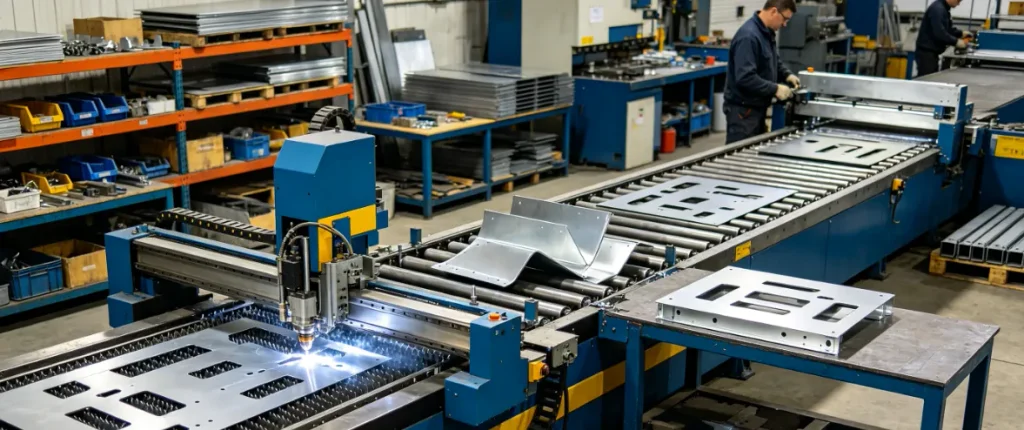
A fabricated component may follow this sequence:
Cutting → Deburring → Bending → Welding → Finishing
The cutting method should fit the operations that follow.
For example, a part going directly into press brake forming needs consistent dimensions and a suitable edge condition. A welded assembly may have different requirements for edge cleanup and fit-up.
This is why custom sheet metal fabrication services can be valuable when a project involves more than flat cutting. Baosheng’s sheet metal capabilities include laser cutting, bending, punching, stamping, welding, riveting, DFM review, and inspection.
For parts that require forming after cutting, see our precision sheet metal bending services.
The best cutting process is the one that supports the complete manufacturing route.
Does Production Volume Change the Best Cutting Process?
The technical requirements may stay the same while the economic choice changes with production volume.
Prototypes and Low-Volume Parts
For prototypes and small batches, flexibility and easy design changes may matter more than maximum machine throughput.
The goal is usually to produce accurate parts without adding unnecessary process complexity.
Repeat Production
Once the design is stable, cycle time, nesting efficiency, repeatability, and secondary operations become more important.
A consistent cutting process can reduce finishing and inspection work across repeated batches.
Higher Production Volumes
At higher volumes, small differences in cutting time, material utilization, finishing labor, and rework can have a significant effect on total production cost.
For this reason, volume should be considered together with geometry and cut-quality requirements.
How Do You Choose the Right Sheet Metal Cutting Process?
Use these seven questions to narrow down the right process.
Step 1: What material are you cutting?
Identify the exact material grade whenever possible.
Carbon steel, stainless steel, aluminum, copper, and brass do not behave the same way during cutting.
Step 2: How thick is the material?
Thickness affects cutting speed, edge quality, heat input, and process capability.
Use thickness as a starting point, not the only selection criterion.
Step 3: Which dimensions are critical?
Identify holes, slots, mating profiles, and other features that affect function or assembly.
Not every dimension needs the same level of process control.
Step 4: What edge quality do you need?
Determine whether the part can accept:
- minor burrs
- dross
- edge taper
- striation
- secondary grinding
Clear edge requirements help prevent unnecessary finishing work.
Step 5: Can the part tolerate heat?
Consider whether heat could affect:
- dimensional stability
- material properties
- surface condition
- downstream machining
If thermal effects are a major concern, evaluate a cold cutting process such as waterjet.
Step 6: What is the total production cost?
Consider:
- material utilization
- setup
- cycle time
- secondary finishing
- production volume
Do not compare processes based only on cutting speed or hourly rate.
Step 7: What happens after cutting?
Determine whether the part will be:
- bent
- welded
- machined
- finished
- assembled
The cutting method should fit the complete fabrication sequence.
Sheet Metal Cutting Decision Matrix
| Part Requirement | Strong Candidate |
|---|---|
| Thin precision sheet metal | Laser |
| Small holes and detailed profiles | Laser |
| Thick conductive plate | Plasma |
| Minimal thermal impact | Waterjet |
| Heat-sensitive application | Waterjet |
| Precision profiles for fabricated parts | Laser |
| Productivity-focused thick plate cutting | Plasma |
| Cutting followed by bending or welding | Laser + downstream fabrication |
These are practical starting points, not fixed rules. Final process selection should be based on the actual drawing, material, thickness, tolerance, geometry, and manufacturing workflow.
What Should You Provide for a Sheet Metal Cutting Quote?
A complete RFQ gives a manufacturer enough information to select a suitable process and quote the finished part accurately.
Basic Part Information
Provide:
- CAD or DXF files
- material specification
- material thickness
- quantity
Engineering Requirements
Also identify:
- critical dimensions
- dimensional tolerances
- edge-quality requirements
- surface finish
- inspection requirements
Avoid applying unnecessarily tight tolerances to every feature. Clearly mark the dimensions that affect fit or function.
Downstream Requirements
State whether the project also requires:
- bending
- welding
- machining
- surface finishing
- assembly
These requirements can affect both cutting process selection and the overall manufacturing route.
A complete RFQ makes it easier to compare manufacturing options based on the finished component rather than the cutting operation alone.
How Can Baosheng Help With Sheet Metal Fabrication?
Baosheng provides custom sheet metal fabrication with laser cutting and downstream processes including bending, punching, stamping, welding, and riveting.
Its workflow also includes DFM review and quality inspection.
This matters when a project includes more than a flat cut profile. The cutting process needs to work with the forming, joining, finishing, and inspection requirements that follow.
Baosheng also supports dimensional and quality inspection as part of its manufacturing process.
Not sure which cutting process fits your part?
Send the CAD or DXF file together with the material, thickness, quantity, and critical tolerance requirements. The part can then be reviewed in the context of its complete fabrication requirements.
Which Cutting Process Is Right for Your Part?
Laser, plasma, and waterjet each have a practical operating range.
Laser cutting is often the stronger choice for thin sheet metal, fine features, controlled dimensions, and efficient production.
Plasma cutting becomes more attractive for thicker conductive plate when cutting productivity and overall economics matter more.
Waterjet cutting is particularly useful when thermal effects need to be minimized or when the material and application favor cold cutting.
The right question is not simply:
Laser vs. plasma vs. waterjet?
It is:
Which process can produce the required part quality at the lowest practical total manufacturing cost?
Choose the process based on material, thickness, geometry, tolerance, edge requirements, thermal sensitivity, production volume, and downstream operations.
Ready to quote your sheet metal parts? Send your CAD or DXF files, material specification, thickness, quantity, critical tolerances, and any bending or finishing requirements for engineering review and quotation.
Frequently Asked Questions
Which cutting method is best for thin sheet metal?
Laser cutting is generally the stronger choice when thin sheet metal requires small holes, detailed profiles, controlled dimensions, and good edge quality. Plasma can still be suitable when the geometry is simple and precision requirements are less demanding.
When should I choose waterjet instead of laser cutting?
Consider waterjet when thermal distortion, heat-related material changes, or material reflectivity create concerns for laser processing. Waterjet is also useful when a cold cutting process is preferred, although it is generally slower for common sheet metal applications.
Is plasma cutting suitable for precision sheet metal parts?
It can be, depending on the equipment, material thickness, geometry, and tolerance requirements. Precision plasma systems can produce improved cut quality, but laser cutting is generally a stronger starting point for thin sheet metal with fine features.
Which cutting process provides the best edge quality?
There is no universal winner for every material and thickness. Laser cutting can produce clean, precise edges on suitable sheet metal. Waterjet provides a cold-cut edge without a conventional HAZ. Plasma can produce good production edges when the system and parameters are properly matched.
Does the cutting process affect downstream bending or finishing?
Yes. Cut dimensions, edge condition, burrs, dross, and thermal effects can influence later fabrication steps. When a part will be bent, welded, machined, or finished, the cutting process should be selected as part of the complete manufacturing workflow.