There are three main types of springs. These are mechanical, gas, and air springs. Springs store mechanical energy and release it when needed. You should have the right knowledge about the types of springs. So this guide will teach you spring types, their features, and general applications.
Main Categories of Springs

As discussed above, springs come into three primary categories:
Mechanical Springs
Mechanical springs use elastic deformation to store energy. For example, you compress, extend, or twist the material, and it returns to its original shape. These springs are very common in suspensions, aerospace engines, and tooling because they are reliable and good in performance.
Gas Springs
Gas springs have compressed nitrogen within a sealed cylinder. A piston rod moves through the gas, creating controlled motion. You will find gas springs in automotive hatches and office chairs.
Air Springs
Air springs incorporate compressed air instead of metal coils. The air pressure provides the spring force. Heavy vehicles and industrial machinery are dependent on air springs for adjustable load support and vibration isolation.
Helical Springs: Types and Applications

Helical springs wind wire into a coil shape. The geometry determines how they will function.
Compression Springs
Compression springs resist axial compressive forces. You push the coils together, and they push back. Subsequently, the wire diameter, coil diameter, and number of active coils define the spring rate.
Open-coiled design allows compression without binding. Therefore, manufacturers leave space between coils in the free state. Spring ends can be closed, ground, or squared, depending on load distribution needs.
Applications
Automotive suspension systems use compression springs to absorb road impacts. You also find them in pens, mattresses, and garage doors. The reason behind industrial valves depends on compression springs because they maintain seal pressure.
Extension Springs
Extension springs store energy when you pull them apart. For instance, initial tension holds the coils together in the resting condition. Subsequently, hooks at each end provide attachment points.
The body stretches under load. Spring rate increases if coils touch during extension. End configurations vary from machine loops to extended hooks.
Applications
Trampolines use extension springs to create bounce. Garage door counterbalance systems employ extension springs to offset door weight. You will find them in carburetors, vise-grips, and exercise equipment. In addition, agricultural machines incorporate extension springs in tillage tools.
Torsion Springs
Torsion springs exert rotational force. You twist the spring around its axis, and it resists. Legs extend from the coil body to apply torque.
The wire experiences bending stress rather than torsional stress despite the name. Next, the coil diameter decreases under load. Body length changes as the spring winds tighter.
Applications
Clothespins use small torsion springs to maintain grip. Clipboards, mousetraps, and hinges incorporate torsion springs for automatic closing. Simultaneously, vehicle suspensions sometimes use torsion bars, which are essentially long torsion springs.
Generally, torsion springs are used in cars and cabinets. The most common example is the spring returns the door to a closed or open position.
Spiral Springs
Spiral springs roll flat strip material into a spiral. In the beginning, the spring comes in a single plane. Then, energy storage comes through the bending of the strip as it unwinds.
The thickness and width of the strip decide the torque output. Furthermore, the number of turns affects total energy storage. Many spiral springs are mounted in a barrel.
Applications
Mechanical watches incorporate spiral springs for the power source. You wind the spring, and it releases energy gradually to push the mechanism. Some common examples include clock movements, timers, and tape measures that use spiral springs.
Recoil mechanisms in power tools often use spiral springs. The spring retracts power cords and extension cables automatically.
Constant Force Springs
Constant force springs provide nearly uniform force throughout their extension. The spring consists of pre-tensioned strips rolled on a drum. Subsequently, force remains constant because the radius of curvature stays consistent.
These springs extend much farther than general extension springs. The force curve stays flat across the working range. Similarly, retraction happens naturally as the spring tries to recoil.
Applications
Tape measures use constant force springs for retraction. The spring pulls the tape back smoothly, and extension length is not important here. The common examples are counterbalance systems in windows and monitors.
Medical devices use constant force springs because predictable tension is important here. Cable retractors and badge holders incorporate them for consistent retraction force.
Leaf Springs: Types and Applications
Leaf springs use flat strips of material stacked to create spring action.
Semi-Elliptical Leaf Springs

Semi elliptical leaf springs stack multiple leaves of decreasing length. For example, the longest leaf sits at the bottom with progressively shorter leaves above. Clips hold the assembly together.
This design distributes stress across multiple leaves. As a result, the spring can handle heavy loads. Subsequently, deflection is there due to the bending of the leaf pack.
Applications
Heavy trucks use semi-elliptical leaf springs in suspension. Because the springs support vehicle weight while absorbing road irregularities. You find them on trailers, railway cars, and older vehicles.
Moreover, industrial machinery incorporates leaf springs where robust load support is important.
Elliptical Leaf Springs
Elliptic leaf springs are made of two semi-elliptical parts that form a complete ellipse. For example, the upper and lower halves collaborate. This design increases the spring rate above that of a single semi-elliptical spring.
The design must be aligned very carefully. The two halves should also deflect equally to avoid binding. The loads are carried at the ends by connection points.
Applications
In the beginning, early carriages and wagons used elliptical leaf springs. The design provided good ride quality for its time. Some vintage car restorations maintain elliptical springs for authenticity.
Modern applications are rare. The complexity outweighs the benefits for most uses.
Quarter-Elliptical Leaf Springs
Quarter-elliptical springs use only one quarter of the ellipse. One end anchors rigidly while the other deflects freely.
This simple design needs a little mounting hardware. The spring works as both a suspension and a locating arm. Furthermore, stress concentrates at the fixed end.
Traditional Applications
Firstly, early automobiles were equipped with quarter-elliptical transverse springs. The design was lightweight and complex. They were widely used in the old horse vehicles in remote areas before better alternatives were found.
Sometimes, old vehicles use quarter-elliptical springs. Not many modern applications exist because of low load capacity.
Three-Quarter Elliptical Leaf Springs
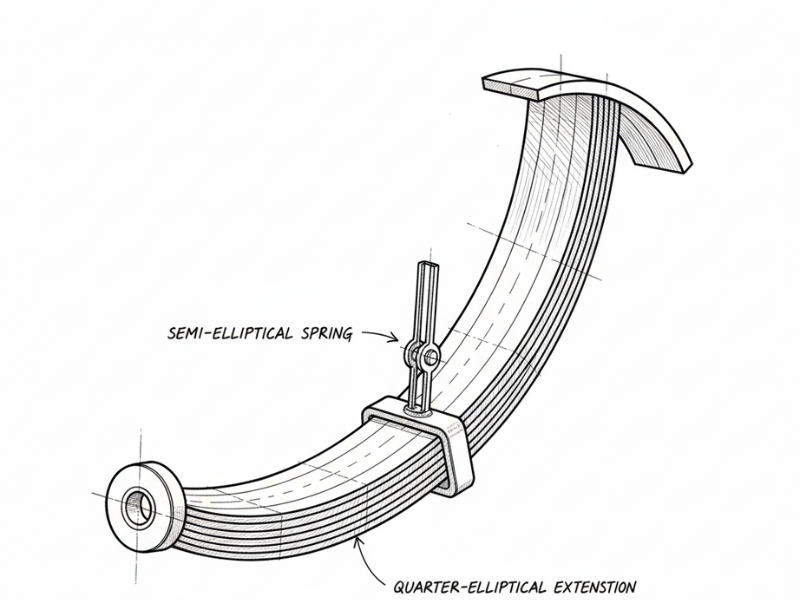
Three-quarter elliptical springs mix a semi-elliptical section with a quarter-elliptical extension. The result is three-quarters of a complete ellipse.
The spring provides different rates in each direction. One end generally anchors while the other attaches to the suspended part.
Applications
In vintage cars, rear suspension could also be three-quarter elliptical springs. The design was able to fit in packaging limitations in the initial chassis design. Carriage suspensions also used this design to enhance the ride quality.
Transverse Leaf Springs
The transverse springs of the leaves are mounted at right angles to the vehicle’s centerline. Similarly, an axle is supported on a single spring. The spring bends when each wheel faces irregularities.
This design saves weight by removing duplicate springs. The spring also acts as an anti-roll bar. Nonetheless, it induces interdependence of right and left suspension movements.
Use Cases
Corvettes famously use transverse composite leaf springs. The design reduces weight and lowers the vehicle. Also, race cars sometimes use transverse springs for packaging efficiency.
The limitation is roll stiffness coupling. What happens on one side affects the other. Most modern vehicles use independent springs for better control.
Disc Springs: Types and Applications
Disc springs use conical washers to create spring force in a compact package.
Belleville Disc Springs
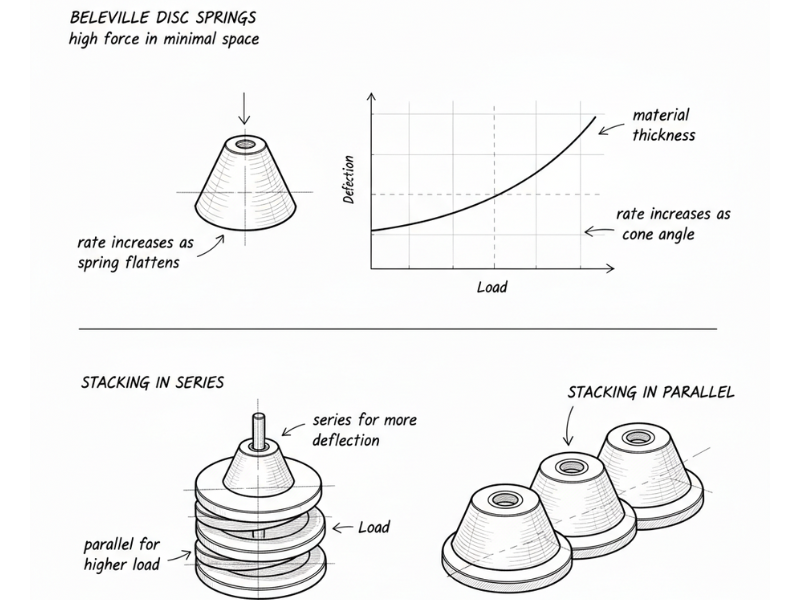
Belleville springs are cone-shaped washers that flatten under load. The conical geometry provides high force in minimal space. You can stack them in series for more deflection or parallel for higher load.
Spring rate varies with deflection. The rate increases as the spring flattens. Material thickness and cone angle focus force characteristics.
Applications
Belleville springs are used in bolted joints to ensure preload. Then disc springs are fitted in clutches as the force to engage.
Belleville springs are preferred in aerospace parts because they are small. They are used in flight control and landing gear.
Curved Disc Springs
Curved disc springs feature a wave-like profile rather than a cone. Multiple waves around the circumference provide the spring action. The design offers lower spring rates than Belleville types.
These springs handle misalignment better than flat washers. The curved profile allows some self-centering. Stacking increases load capacity.
Applications
Curved disc springs are used in bearing preload parts. The springs are used to counter the wear and expansion. They are used in electric motors and gearboxes to keep the bearing position.
Moreover, in some cases, assemblies of clutches show curved disc springs. A progressive rate is appropriate given the engagement requirements.
Slotted Disc Springs
Slotted disc springs include radial cuts in the disc. The slots reduce stress concentrations and allow greater deflection. In turn, the design trades some load capacity for increased flexibility.
Slots prevent buckling in high-deflection applications. The disc can flatten more completely. Multiple slots distribute stress more evenly.
Applications
Slotted disc springs are used in high-deflection clutches. The slots allow the spring to compress even more without breaking. They are used in racing transmissions.
In addition, industrial couplings use slotted springs to take up shock loads. The higher deflection generally protects the equipment attached.
Wave Disc Springs
Wave disc springs have multiple waves around the circumference. Three or four waves are common. The spring compresses as the waves flatten.
These springs provide light loads with good deflection. The design minimizes stress compared to Belleville types. Assembly requires less force.
Applications
Wave springs are used to remove play in thrust bearings. The springs do not have too much preload. You can find them in small motors and fine parts.
Moreover, wave springs are used in seals and gaskets for good compression. They are used in valve bodies and clutch packs of automotive transmissions.
Specialized Spring Types
Some applications require unique spring designs beyond standard categories.
Gas Springs
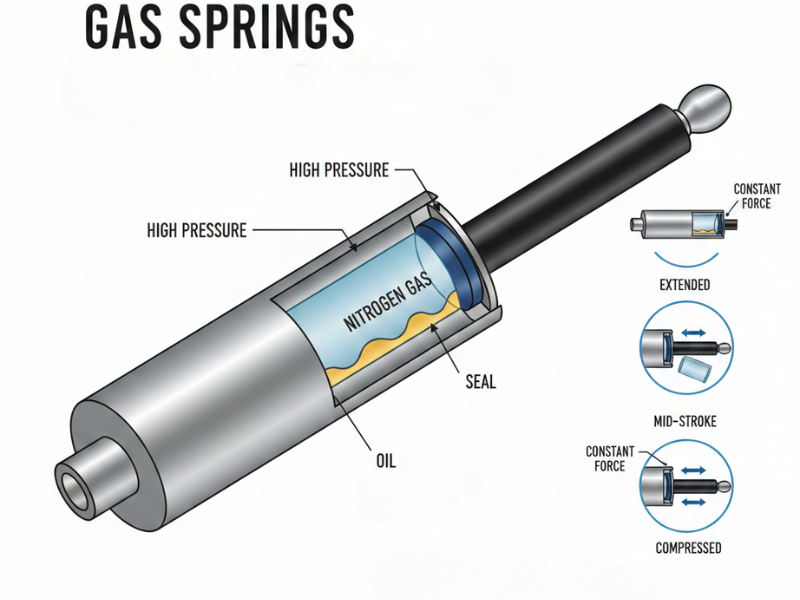
Gas springs contain high-pressure nitrogen in a sealed cylinder. A piston rod extends through a seal. Oil inside dampens motion and lubricates the seal.
Pressure remains constant regardless of position. Force equals pressure times piston area. Temperature changes affect pressure slightly.
Applications
Gas springs are used to open the hatches and hoods of automobiles. The office chairs have gas springs to adjust their height. They are used in hospital beds and industrial machines for controlled motion.
Also, tool boxes and storage compartments rely on gas springs. The damping reduces the chances of sudden closures to avoid any injury.
Air Springs
Air springs use flexible rubber bellows containing compressed air. Air pressure creates the spring force. You can adjust stiffness by changing pressure.
The spring rate is progressive. Force increases non-linearly with compression. Large deflections are possible with low solid height.
Applications
The semi-truck suspensions are loaded with air springs. They are used in buses to achieve high ride quality. Railway cars incorporate air springs to decouple the passengers from the rails.
Subsequently, industrial vibration isolation machines have air springs. The flexible stiffness can be changed to different load conditions.
Machined Springs
Machined springs are cut from solid bar stock. No coiling process occurs. The spring shape comes entirely from material removal.
Complex geometries are possible. You can create features impossible with wire forming. Tolerances are tighter than coiled springs.
Common Applications
Machined springs are used in aerospace components where accuracy is important. They are designated in medical parts to have valuable uses. The foreseeable characteristics fit life-safety equipment.
Moreover, small electronics springs are usually machined. The process is appropriate for miniature sizes and exotic materials.
Flat Springs
Flat springs use thin metal strips bent into functional shapes. The strip remains essentially flat. Deflection occurs through the bending of the strip.
These springs integrate easily into assemblies. You can stamp complex shapes economically. The thin profile suits tight spaces.
Common Applications
Battery contacts use flat springs. Switches and relays incorporate them for electrical connection. Electronic connectors incorporate flat springs for contact force.
Furthermore, automotive door latches employ flat springs. The simple design reduces cost with reliable performance.
Spring Materials and Their Properties
Material selection significantly affects spring performance and longevity.
Steel Alloys
Spring steel offers excellent strength-to-weight ratios. The material handles high stress and provides good fatigue life. Heat treatment optimizes mechanical properties.
Carbon content ranges from 0.5% to 1.0% for most spring steels. Higher carbon increases strength but reduces ductility. Manganese improves hardenability.
Low-Alloy Steels
Chromium-vanadium steel resists fatigue better than plain carbon steel. You find it in high-stress applications such as valve springs. Chromium-silicon steel suits elevated temperatures.
These alloys cost more than basic spring steel. The improved properties justify the expense in demanding applications.
Beryllium Copper Alloy
Beryllium copper combines electrical conductivity with spring properties. The material resists corrosion in harsh environments. You can age-harden it for optimal strength.
Electronics use beryllium copper for contact springs. Marine applications specify it for saltwater resistance. The material costs significantly more than steel.
Ceramic Materials
Ceramic springs handle extreme temperatures. The material does not creep at elevated temperatures. However, brittleness limits applications.
Research reactors use ceramic springs in high-radiation environments. Some aerospace parts are specified with ceramics for thermal stability.
Composite Materials
Fiberglass and carbon fiber create lightweight springs. The materials resist corrosion completely. Fatigue properties rival steel in specific loading modes.
Race car suspensions sometimes use composite leaf springs. Weight savings improve performance. However, cost limits widespread adoption.
Rubber and Urethane
Elastomeric materials provide springs for low-force applications. The materials dampen vibration naturally. Temperature affects properties significantly.
Vibration mounts use rubber or urethane springs. The material isolates sensitive equipment. Also, automotive bushings incorporate elastomeric springs.
Material Selection Considerations
First, you need to consider operating temperature, which decides material viability. Corrosive environments require resistant alloys. Load cycles affect fatigue life requirements.
Cost balances against performance needs. Standard materials suit most applications. On the other hand, exotic materials solve specific problems.
Conclusion
There are many different types of springs used to help machines work. If you want to get one, you should look at how much weight it needs to hold and how much space you have. Getting knowledge about spring working will help you choose a suitable spring for your project.